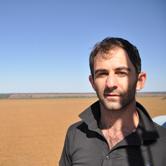
PhD Student
Research Description
I research how to reduce the environmental burdens and increase the social benefits from production activities.
Motivated to identify greenhouse gas mitigation strategies, my dissertation research seeks to better explain the places, markets, production practices and people that shape and have the potential to change patterns of land use in Brazil. The most surprising insight has been the importance of growth and change in markets and governance well beyond the gates of the farms where I do my field research. These sorts of changes can make climate-beneficial short-run land use management strategies costly in the long run and vice-versa. This insight coupled with knowledge gaps on the relationship between agricultural practices and local environmental quality underscores the need for more accessible, better-documented data. It is why I build publicly available datasets on salient and often underrepresented cultural, institutional and agroecological variables with implications for reducing greenhouse gas emissions associated with agricultural practices. Thus far, I have focused mostly on representation of biophyisical and socioeconomic determinants of marginal lands, and also the representation of extensive tropical livestock systems. The datasets I make are useful for shaping future inquiry, for comparison with empirical data and as base data for efforts to model land use change processes. Details about this and other aspects of my research can be found below.
Determinants of Agricultural Intensification Mato Grosso State, Brazil (with Mike O’Hare and David Zilberman) – A number of initiatives in Brazil aim to encourage intensification of agricultural and ranching systems in order to spare land for forests and productive uses. Yet the potential benefits of these plans are unknown because of knowledge gaps about the direct environmental impacts of intensification and also about how intensification programs would affect farmer behavior. I am conducting survey research in Mato Grosso State, Brazil to examine several key socio-economic determinants of the intensification and environmental effects of intensification programs. Administered to a mixture of soy and cattle farmers, the survey addresses how and why agricultural intensity varies in the first place and also examines potential unintended consequences on farmer behavior of intensification interventions. As data collection concludes we will soon be able to examine, at the farm level, the relationship between farm intensity, farm technology, farmer demographics, agri-climatic aptitude and agricultural transportation costs to determine where and how incentives would affect intensification and extensification of agriculture in Mato Grosso, Brazil.
Improving the Representation of Rangelands in Land Use Change Simulation Models (with Mario Herrero, Aline Mosnier and Erik Schmidt) - 25% of the world’s land surface is rangelands, but their biophysical and socio-economic characteristics are often poorly represented in simulation models used to predict land use change. This can have grave implications for the design of policies for reducing deforestation or mitigating climate change. In this project I work with experts on rangeland productivity and cattle ranching systems to build improved representations of extensive cattle ranching systems in Brazil.
Examining the Climate Mitigation Potential of Cattle Ranching Intensification Policies in Brazil(with Maria Bowman, David Zilberman and Kate O’Neill) - In Brazil, momentum is growing to develop incentives to encourage cattle ranchers to adopt already-commercially-available technologies to intensify land use. The conventional wisdom is that by increasing cattle output per unit of ranchland, cattle ranching intensification programs (CRIPs) could reduce deforestation and increase the area of land available to produce biofuels. We describe the rise of support for Brazilian CRIPs, their rationale, and the enormous potential for climate benefits from CRIPs. We then identify intricate scientific and political considerations for designing policies that could deliver climate-beneficial CRIPs. We trace how poor data and limited scientific understanding of Brazilian cattle systems may have led to the current popularity of CRIPs and could undermine the design and implementation of CRIPs in the future. The urgency of terrestrial climate challenges and the rapid development of climate policy regimes shape our conclusions on how to approach CRIPs with limited information, weak governance, slow-to-develop benefits and potentially immediate costs.
Simulating the Climate Effects of Brazilian Cattle Ranching Intensification Policies (with Petr Havlik, Aline Mosnier and Hugo Vailin) - Cattle ranching intensification policies are central to Brazil’s plans to mitigate climate change, but they have the potential to create numerous unintended consequences with important implications for Brazil’s climate mitigation targets themselves. Using a version of the Globiom simulation model specially tailored for Brazilian agricultural systems, we find that boosting cattle density in Brazil could greatly reduce global greenhouse gas emissions from land use change, but not by sparing Brazilian land for forests and fuels. According to our simulation, subsidizing greater cattle density in Brazil might increase substantially the amount of cattle products Brazil produces, but might not actually prevent an increase in the overall area of pasture in Brazil. Thus, such a subsidy for the intensification of ranching might prevent Brazil from meeting its own GHG reduction targets and could lead to trade disputes in response to the flood of cheap Brazilian beef.
I have also been (or still am) a collaborator on the following projects.
The Impacts of the Soy Moratorium on Land Use and Land Use Governance in Mato Grosso State, Brazil (with Holly Gibbs and Rachael Garrett) - One of the stiffest challenges to the implementation of Reduced Emissions from Deforestation and Forest Degradation is the lack of government institutions to enforce deforestation prevention programs. NGO-initiated initiatives like the Soy Moratorium seek to compel the build-out of alternative mechanisms to prevent deforestation. In this project we examine the impacts on governance and land use of the soy moratorium in Mato Grosso State, Brazil.
New Directions in Global Environmental Governance: Methods for Studying Complexity, Linkage and Scale (with Kate O’Neill, Erika Weinthal, Ben Cashore, and Steve Bernstein) - In recent years the field of Global Environmental Governance has expanded to include a much broader constellation of actors than governments alone. In this project we review how this change has and should affect methods used in the field.
Identifying Constraints to the Development of Brazilian Agribusiness (with David Zilberman and Madhu Khanna) – This research seeks to examine why despite seemingly favorable economics Brazilian agriculture production hasn’t grown faster in recent decades. We examine the constraints on investment, infrastructure, political, technological and environmental factors shaping Brazilian agricultural development.
Contact Information
Email: avery@berkeley.edu
Office: 145 Hilgard Hall
Website(s)
Research Group(s)
Mailing Address
Dept of Environmental Science, Policy, & Management
UC Berkeley
130 Mulford Hall #3114
Berkeley, CA 94720
Connect with Us